
Pasture, Rangeland, and Forage (PRF) Insurance Expansion and Emerging Limits to Growth

by Francis Tsiboe, Walker Davis, and Dylan Turner
Within the Federal Crop Insurance Program, the standard approach to offering insurance is to establish a baseline level of production (i.e. the yield) and then set an insurance guarantee that ensures a level of financial protection equal to some portion of the baseline level of production. This method is appropriate for most crops that are planted and harvested on an annual basis.
Forage crops, however, are unique since they can either be planted and harvested for hay or seed, or continuously grazed by livestock on pasture or rangeland (Turner and Tsiboe 2024). Harvested forage fits within standard crop insurance programs since yields can be measured and the product is clearly defined (“Forage only” or “Forage seed” in Figure 1). For continuously grazed systems, the Risk Management Agency (RMA) offers the Pasture, Rangeland, and Forage (PRF) insurance plan. PRF provides area-based coverage using a rainfall index to estimate precipitation and determine payouts, rather than measuring yield directly. This approach is well-suited for grazed forage systems where yield cannot be measured because forage growth is never harvested. When precipitation falls below the long-term average in a producer’s area, indemnity payments are triggered to offset expected forage losses (Turner et al. 2023).
Figure 1: United States Insurance Program Liability and Net Acres Insured for Forage, Range, And Pasture.

Source: Agricultural Risk Policy Center, NDSU, using data from USDA Risk Management Agency (RMA).
Even though the Pasture, Rangeland, and Forage (PRF) program remains officially classified as a pilot, it became available nationwide in 2016. That year, about 52 million acres were enrolled, with insured liabilities totaling $1.4 billion. By 2025, enrollment had expanded to 316 million acres, and liabilities had risen nearly fivefold to $6.9 billion (Figure 1). The most significant growth occurred between 2016 and 2022, as producers in newly eligible regions adopted PRF to manage forage production risks tied to variable rainfall. Enrollment surged from 52 million acres to nearly 247 million acres during this period, reflecting both expanded program access and greater producer awareness. By 2023, PRF had become a core component of the federal crop insurance portfolio, covering 289 million acres with more than $5.9 billion in insured liabilities. Since then, growth has slowed, with enrollment increasing only modestly from 296 million acres in 2024 to 316 million acres in 2025, suggesting the program may be reaching saturation in key forage-producing regions. This rapid expansion raises two key questions: has enrollment peaked, and how much additional pasture and rangeland remain eligible for coverage?
Figure 2 (Section A) shows the progression of PRF acreage penetration across the continental United States from 2016 to 2025. Each map reports the share of insured acres in each county enrolled in PRF relative to total PRF-eligible acres. When PRF became available nationwide in 2016, program penetration was minimal. Only 12.01% of total PRF-eligible acres were enrolled in PRF, and most counties across the eastern half of the U.S. showed little to no participation in the program. Early adoption occurred primarily in the West South Central and West North Central census regions. Interestingly, at the beginning of PRF being offered, areas where ranching and forage-based livestock systems are dominant, such as the Mountain West, initially saw little penetration. From 2017 to 2020, participation increased steadily, with national penetration rising from just over 17.7% to almost 38.5%. This early growth in penetration reflected both the expansion of knowledge about program availability and producer familiarity with using rainfall index insurance to manage forage risk.
The most significant growth occurred between 2020 and 2023, during which PRF acreage penetration increased from less than a quarter of insured acres to almost 70%. During this time, enrollment quickly grew across the Mountain West and West South-Central regions, following the areas where forage production for livestock is a key industry. By 2025, over three-quarters of all insurable acres nationwide were enrolled in PRF, with several counties across the western US reaching 100% of insured acres in PRF, demonstrating full program penetration. With essentially all insured acres covered under PRF in these areas, it again raises questions about how much more room there is to grow and whether there is any room at all in regions that possess significant amounts of pasture and rangeland.
Regions with the highest PRF enrollment tend to match those with an abundance of forage and limited other crop enterprises in which other insurance options would be used. Conversely, the Midwest, Southeast, and Northeast have very low PRF penetration, with enrollment shares below 25% at the state level, except in Florida, Kentucky, and Ohio, as shown in part B of Figure 2. These regions concentrate primarily on row crops and rely on traditional yield and revenue-based insurance programs rather than rainfall index insurance, which is designed for forages. Even in parts of the Midwest and South where pasture and rangeland acres are available, participation remains low compared to the West. This is partly an artifact of the data and how PRF eligible acres are designated. Importantly, this analysis designates a PRF eligible acre if at any point during 2008-2024 it was identified in the USDA Forest Service Rangelands V1 dataset or classified as pasture, grass, shrub, or hay from the USDA NASS Cropland Data Layer. This means that crop acres that may be part of a rotational grazing practice or are occasionally planted with a forage crop still are classified as PRF eligible. Thus, low participation in the eastern portion of the U.S. is likely emblematic of the region’s suitability for cultivation of traditional commodity crops.
Notwithstanding this caveat, Western states dominate PRF participation, with Arizona, Utah, Nevada, Idaho, and Oregon reporting 100 percent penetration, and several others, including California, Wyoming, and New Mexico, achieving penetration rates above 70 percent. In contrast, nearly all states east of the Mississippi River remain comparatively low, despite some, such as Kentucky, Tennessee, and Missouri, having significant pasture and hay resources. This uneven distribution further points to the program’s success in reaching its target audience, which is producers dependent on rainfall-driven forage systems with massive acres of eligible land. It also, however, shows that there are remaining opportunities for growth in underrepresented regions.
Figure 2: United States Acreage Penetration of the Pasture, Rangeland, and Forage Program, Measured Against All PRF-eligible Acres
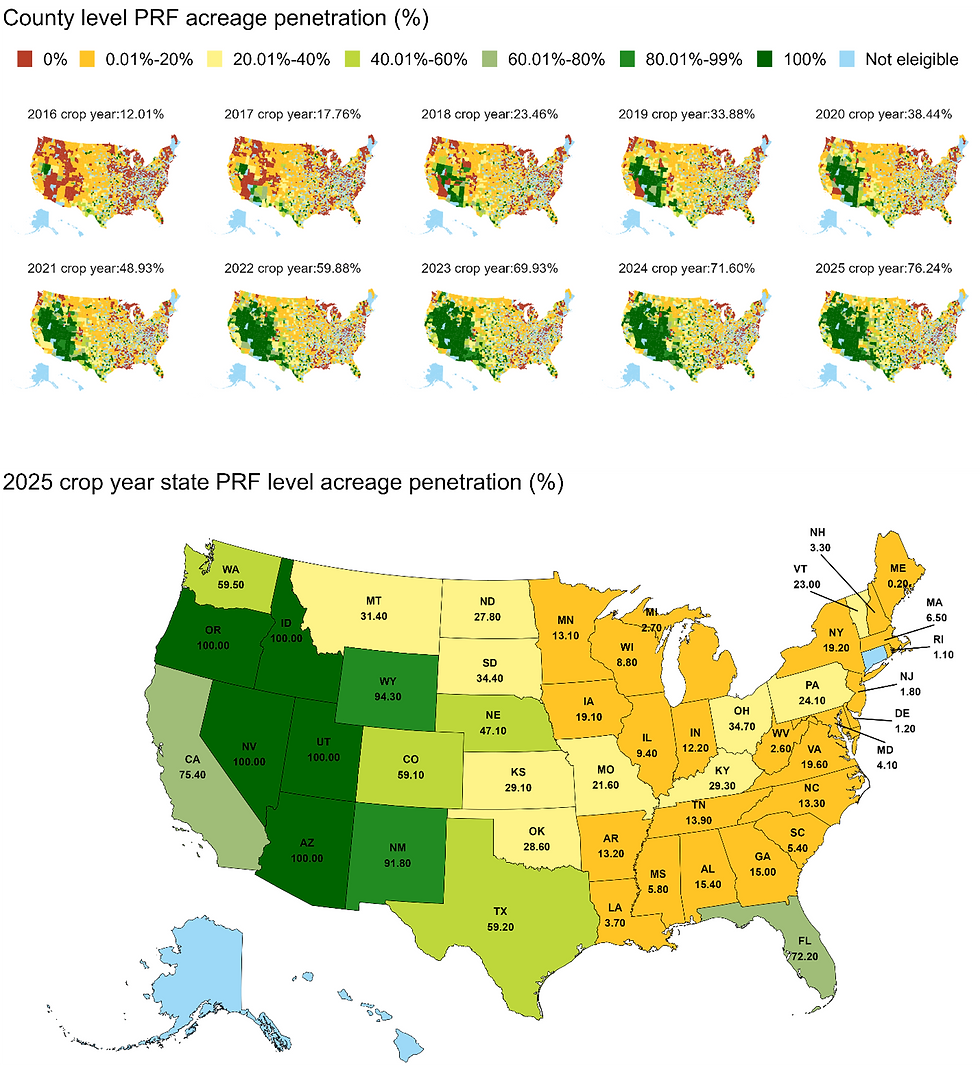
Notes: County acreage eligibility for PRF is defined as the total land area within each PRF rainfall-index grid cell that satisfies specific land-cover criteria. Eligible land must contain either rangeland vegetation identified in the USDA Forest Service Rangelands V1 dataset or pasture, grass, shrub, or hay classes from the USDA NASS Cropland Data Layer (CDL; 2008–2024). In addition, every eligible pixel must meet an unpopulated-land requirement (population density equal to zero) based on the 2010 USGS block-level population-density raster, ensuring exclusion of developed and urbanized areas. To maintain consistency with grazing-use expectations, we assign ineligibility to grids in a county only if that county and all of its contiguous counties report zero January-1 inventory of cattle (including calves), goats, and sheep (including lambs) for all years from 2000 through the current year. Finally, preliminary county-level eligible acreage estimates produced by this procedure are capped at the maximum agricultural land acreage reported for each county in the Census of Agriculture (2002–2022).
Source: Agricultural Risk Policy Center, NDSU, using data from USDA Risk Management Agency (RMA), USDA National Agriculture Statistics Services (NASS), and USGS.
Overall, the decade-long trajectory shown in Figure 2 suggests that PRF adoption has transitioned from a rapid expansion phase to a period of slower, more incremental growth. The leveling of penetration rates, as well as the number of acres enrolled (as shown in Figure 1), since 2023 shows that the PRF program may be approaching saturation in its core pasture and rangeland areas. Future increases will likely mean depending less on expanding coverage in the West and more on engaging new producers and expanding knowledge of the program in areas where enrollment remains limited. Ongoing ARPC-led research on understanding why these gaps persist, whether due to producer awareness, actuarial performance across regions, or differences in forage management and operations, will be crucial to assessing the program’s further development.
References
Turner, D., and F. Tsiboe. 2024. “Pasture, Rangeland, and Forage Drive Increased Participation in Federal Crop Insurance Program.” Amber Waves - U.S. Department of Agriculture, Economic Research Service. Available at: https://www.ers.usda.gov/amber-waves/2024/june/pasture-rangeland-and-forage-drive-increased-participation-in-federal-crop-insurance-program/ [Accessed July 12, 2024].
Turner, D., F. Tsiboe, K. Baldwin, B. Williams, E. Dohlman, G. Astill, S. Raszap Skorbiansky, V. Abadam, A. Yeh, and R. Knight. 2023. “Federal Programs for Agricultural Risk Management.” EIB-259, U.S. Department of Agriculture, Economic Research Service. Available at: https://www.ers.usda.gov/publications/pub-details/?pubid=108166.
Related Research and Policy Analysis by ARPC Economists:
Tsiboe, F., and Zhao, H. (2025). Crop Insurance Premium and Interest Deferrals in a Time of Rising Farm Costs. ARPC Brief. https://www.arpc-ndsu.com/post/crop-insurance-premium-and-interest-deferrals-in-a-time-of-rising-farm-costs
Turner, D., and F. Tsiboe. (2024). “Pasture, Rangeland, and Forage Drive Increased Participation in Federal Crop Insurance Program.” Amber Waves - U.S. Department of Agriculture, Economic Research Service. https://www.ers.usda.gov/amber-waves/2024/june/pasture-rangeland-and-forage-drive-increased-participation-in-federal-crop-insurance-program/
Turner, D., F. Tsiboe, K. Baldwin, B. Williams, E. Dohlman, G. Astill, S. Raszap Skorbiansky, V. Abadam, A. Yeh, and R. Knight. (2023). “Federal Programs for Agricultural Risk Management.” EIB-259, U.S. Department of Agriculture, Economic Research Service. https://www.ers.usda.gov/publications/pub-details/?pubid=108166


Comments